Serge Viallelle
The WhaleSerge Viallelle appears in the account of the Azores as a catalyst in the islands’ transition from whaling to whale-watching. A Frenchman who came in the 1980s to deliver a yacht, he discovered the whales and stayed; later, he had to persuade islanders that visitors would pay simply to look at them. His story turns on a reversal: the whales that had sustained a local hunting economy could also support a livelihood based on their continued presence.
Arrival and discovery
Viallelle arrived in the Azores in the 1980s, delivering a yacht. The account describes him as a drop-out who discovered the whales and remained on the islands. It gives no further detail about his earlier life or the circumstances of his decision to stay, but makes his encounter with the whales the beginning of his involvement in the changing local relationship with them.
Recording the old hunt
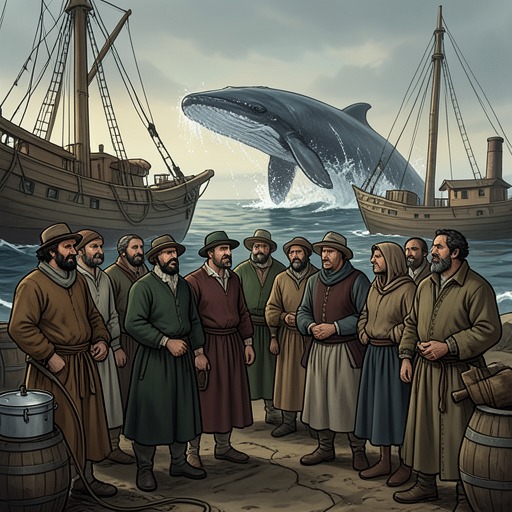
In a converted boathouse on the quayside, Viallelle shows the narrator film of Azorean whaling from the 1970s. The footage records a practice that retained the appearance of an earlier era: crews used boats resembling those of Yankee whalers, later towed out by motorboats, while watchers stationed in cliff-top vigias scanned for whales. At a signal, crews left their ordinary work and went to sea. By presenting this film, Viallelle makes the island’s recent whaling history visible—not as a remote tradition, but as something recorded within living memory.
The account also links him to one of the material remnants of that history. Outside a restaurant on Pico, an engine starts; Viallelle identifies it as the original motorboat once used to tow the canoas. He says its sound frightens whales away for miles. The boat is therefore more than a relic: the same technology that once helped hunters reach the whales now figures in a changed economy in which keeping them nearby matters.
From hunting to whale-watching
The end of commercial whaling in the Azores followed several pressures. Island residents found other work, demand for whale products diminished, and the Azores’ entry into the European Union brought a prohibition on whaling. Viallelle’s role was to help make whale-watching imaginable as an alternative. The account compares this transition with Provincetown, where whale-watching also replaced hunting, and notes that Al Avellar, a Provincetowner of Portuguese descent, taught the Azoreans their new trade.
Viallelle’s significance lies in this work of translation between livelihoods. The film he presents preserves the practical knowledge and violence of the hunt as evidence of what the islands are leaving behind; his persuasion directs attention toward a different value in the whales, one based on looking rather than taking. The ending is not a claim that the past has disappeared: the old motorboat remains, but, in Viallelle’s account, its noise now drives whales away.